

Quick answer
Cumin, jeera, is the workhorse of the Ayurvedic kitchen, and it does its work at the small food-level amounts anyone can manage. In moderate quantities it suits pitta, especially toasted and combined with cooling coriander and fennel as in CCF tea, though large amounts on its own can aggravate pitta because cumin is heating. For loose motions, toasted cumin powder stirred into buttermilk is the classic Indian remedy, and anything persistent needs proper medical attention instead.
Cumin (jeera) is the workhorse of the Ayurvedic kitchen. Almost every dal, curry and rice dish in classical Ayurvedic cooking begins with cumin seeds toasting in ghee. Taste is only part of the reason. Cumin does deep, steady work in the body, and it does it at the small, daily, food-level amounts anyone can manage.
This page covers what cumin is and which seed you are actually buying, what Ayurveda says it does, how it behaves in each of the three doshas, four preparations with real quantities, when to leave it alone, and what modern research has and has not shown. If you only take one thing away, take the tadka method further down. It is thirty seconds of work and it changes how a meal sits.
Which seed is actually cumin?
Four seeds get sold under overlapping names, and shops are inconsistent about it. Getting this straight matters, because they taste different, behave differently in the body, and are not interchangeable in a recipe.
| Seed | Botanical name | Looks like | Tastes like |
|---|---|---|---|
| Cumin, jeera, safed jeera | Cuminum cyminum | Pale greenish-brown, ridged, boat-shaped, about 5mm | Warm, earthy, slightly bitter, unmistakably curry |
| Black cumin, kala jeera, shahi jeera | Bunium persicum | Darker, thinner, more curved and finer than jeera | Sweeter, smokier, more perfumed and much less blunt |
| Caraway | Carum carvi | Dark brown, curved, tapered at both ends | Anise and dill, closer to rye bread than to curry |
| Kalonji, black seed, nigella | Nigella sativa | Matte black, angular, not seed-shaped at all | Peppery and oniony, a little like oregano |
Ordinary cumin is what almost every Ayurvedic recipe means by jeera, and it is what this page is about unless it says otherwise. It is cheap, widely available and the one to keep in quantity.
Black cumin is a genuine relative, grown in Kashmir, Iran and Central Asia, and it is expensive because it is mostly wild-harvested. In the kitchen it goes into biryani, Kashmiri dishes and Mughlai cooking, where its sweeter, smokier note is the point. In Ayurvedic terms it is treated as lighter and more warming than ordinary jeera, and it is used in smaller amounts. If a recipe calls for shahi jeera, use black cumin, not more of the regular kind.
Caraway is where most of the confusion starts. It is a close botanical cousin in the same family as cumin, it looks similar enough to fool anyone, and in some shops it is labelled black cumin or even shahi jeera. It tastes nothing like cumin. If your dal comes out tasting faintly of rye bread, this is why.
Kalonji is not a cumin at all. It belongs to a completely different plant family, and its confident English name of black cumin has caused decades of muddle. It is the seed in the black-seed oil sold in health shops, it has its own long tradition of use, and it is scattered on naan and pickles. Buying it for a cumin recipe will not work.

Cumin and the spaces between tissues
In Ayurveda, the body is built of seven tissues (dhatus). As food is digested, it moves from one dhatu to the next, and at each step it must cross a tiny gap where the actual transformation happens. Cumin is famously good at cleaning these gaps, so nutrients pass cleanly through to the next tissue rather than getting stuck along the way.
That is why cumin turns up in Ayurvedic advice for problems that look unrelated to digestion. Dull skin, low energy, thin hair and poor recovery are all read as nutrition failing to reach the tissue that needs it, not as a shortage of food. A spice that keeps the channels clear helps everything downstream of them, which is the logic behind putting a teaspoon of cumin in nearly every savoury dish rather than saving it for the days when your stomach is playing up.
What cumin does
- Burns ama. Cumin clears the sticky, undigested residue that lodges in tissues and clogs the channels.
- Improves absorption. When the gut wall is healthy and the gaps are clean, the body actually extracts the nutrition from food. Cumin is one of the best spices for this.
- Soothes a bloated stomach. Cumin breaks up gas and calms a swollen, uncomfortable belly.
- Eases diarrhoea. Counter-intuitively for a digestive spice, cumin can settle loose motions by warming the gut and helping it reabsorb fluid.
- Builds beneficial gut flora. By burning toxins and creating a healthy environment in the colon, cumin lets the good bacteria flourish.
- Increases breast milk flow in lactating mothers.
- Kindles agni without scorching it. Cumin raises digestive fire more gently than chilli, black pepper or dry ginger, which is why it can be used every day by people who cannot tolerate hotter spices.
- Settles nausea and morning queasiness. A weak cumin infusion, sipped warm, is a standard household remedy across India.
Cumin’s properties
Predominant tastes: pungent and astringent. Energy: slightly heating. Post-digestive effect: pungent. In dosha terms, cumin pacifies vata and kapha; in moderate amounts it is fine for pitta, but excess can aggravate it.
Those three lines are the classical shorthand for any Ayurvedic substance, and they are worth unpacking. Rasa is the taste on the tongue, and pungent with astringent explains both the immediate warming and the slight drying you feel after a strong cup of cumin tea. Virya is the energy after swallowing, and cumin’s mild heat is what makes it safe daily where hotter spices are not. Vipaka is the effect after digestion is complete, deeper in the tissues; cumin’s pungent vipaka is why it keeps working on the channels long after the meal is over. Cumin is also described as laghu (light) and ruksha (dry), which is the single most useful fact about it. Light and dry is why it clears heaviness and congestion, and light and dry is also why it can tip an already dry person into constipation.
Cumin across the three doshas
The same teaspoon of cumin does three different things depending on who is eating it and how it has been prepared. Whether it suits you is mostly a question of what you cook it in.
Cumin for vata
Cumin is close to ideal for vata. It is warm where vata is cold, it moves gas downward and out where vata pushes it upward and sideways, and it steadies an appetite that comes and goes. The one caution is dryness. Vata is already dry, and cumin is drying, so the vata rule is that cumin should almost never be eaten without fat. Fry it in ghee, add it to an oily dal, stir it into soup with a spoon of olive oil. Cumin in ghee pacifies vata; cumin in dry-roasted form on top of a raw salad can make a vata person worse. If you tend towards constipation, keep cumin in company with fennel and coriander, both of which are moistening enough to offset it.
Cumin for pitta
Cumin is the one warming spice that pitta can usually keep. Its heat is mild, its bitterness is cooling in effect, and its classical uses include several genuinely pitta-friendly ones: toasted cumin in buttermilk after lunch, cumin in a cooling coriander chutney, cumin with cucumber and yoghurt. The limits are real, though. Once there is active heat in the system, meaning reflux, gastritis, hot rashes or a flare of anger, cumin in quantity will add to it. The practical rule for pitta is small amounts, always toasted, always with something cooling alongside. Sweet, bitter and astringent partners such as coriander, fennel, mint, coconut and yoghurt are the right company. Chilli, mustard and dry ginger are not.
Cumin for kapha
Kapha gets the most obvious benefit and the fewest cautions. Kapha is heavy, cold, wet and slow; cumin is light, warm and dry, which is the exact opposite on every axis. It cuts through the heaviness after a big meal, dries up mucus, and pushes a manda agni into doing something. For kapha the preparation flips: dry-toast the seeds in a pan rather than frying them in a spoonful of ghee, and pair cumin with ginger, black pepper or mustard seed rather than with cooling herbs. A cup of cumin and ginger tea mid-morning does more for kapha sluggishness than most things you can buy. The general principles for all three types are set out in our guide to the Ayurvedic diet.
How to use cumin every day
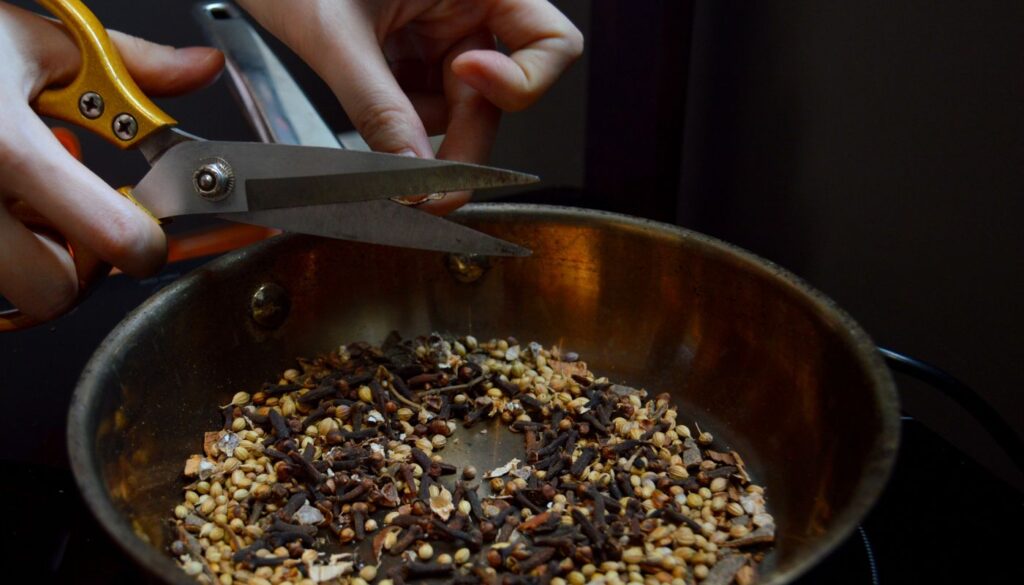
- Toast first. Whether you’re using whole or ground cumin, dry-toast or fry briefly in ghee before adding to food. Untoasted cumin is harder to digest.
- The classic CCF tea. Equal parts cumin, coriander and fennel simmered in water. Sip throughout the day for steady, gentle digestion.
- In dal. Heat a tablespoon of ghee, add a teaspoon of cumin seeds, let them sizzle, then pour over cooked dal at the end. This is called tadka and it transforms the dish.
- With beans and lentils. Cumin is unmatched here. It ensures these heavier proteins don’t cause gas and bloating.
- In drinks. Toasted cumin powder mixed into buttermilk (chaas) is the traditional Indian post-lunch digestive.
- Buy whole, grind small. Ground cumin loses its volatile oils within a few months. Buy whole seed, grind a couple of tablespoons at a time in a spice grinder or mortar, and keep it in a jar away from the hob.
Four preparations, with quantities
Most cumin advice online stops at the word regularly. Here are the four preparations that actually get used, with amounts and timings you can follow tonight.
Jeera water (jeera pani)
The simplest cumin preparation and the one most people start with. Two methods, both worth knowing.
- Overnight soak. Put 1 teaspoon of whole cumin seeds (roughly 2g) into 250ml of room-temperature water before bed. In the morning, strain and drink at room temperature or gently warmed. This gives a milder, less drying result and suits vata best.
- Simmered. Bring 1 litre of water to the boil, add 1 heaped teaspoon of cumin seeds, simmer for 5 minutes, cover, and let it stand for 10 more. Strain into a flask and sip warm across the day. This is the stronger version and suits kapha best.
Timing. The first cup goes 20 to 30 minutes before breakfast, on an empty stomach. After that, sip between meals rather than with them, since a lot of liquid alongside food dilutes digestion rather than helping it. Stop drinking it after about 6pm if it interferes with your sleep.
How long. Run it for two weeks, then look honestly at what changed. Jeera water is a corrective, not a permanent fixture. If bloating and heaviness have settled, drop back to a few days a week or reserve it for the season when you need it. If nothing has changed in two weeks, the problem is somewhere else and more cumin will not find it. Anyone with reflux, gastritis or a strong pitta imbalance should use the weaker overnight version and halve the seed.
CCF tea, with exact ratios
The base recipe is equal parts by volume. For a single cup, use one third of a teaspoon each of cumin seed, coriander seed and fennel seed in 250ml of water. For a flask that lasts the day, use 1 teaspoon of each in 1 litre. Bring to the boil, simmer 5 minutes, then cover and steep for another 5 to 10 before straining. Drink it warm, between meals, up to about a litre a day.
The equal-parts version is a good default, but the ratio is where the skill is. Adjust it to what is actually happening:
- For vata (gas, bloating, irregular appetite), keep the cumin at a full third and add a pinch of ajwain or a few crushed fennel seeds extra. Drink it hot rather than warm.
- For pitta (acidity, heat, irritability), cut the cumin to a quarter teaspoon and raise the coriander and fennel to a half teaspoon each. Let it cool to lukewarm before drinking.
- For kapha (heaviness, mucus, sluggish digestion), keep the cumin, halve the fennel and add two or three slices of fresh ginger to the simmer.
Tadka, the thirty-second method
Tadka is hot fat used to carry a spice into a finished dish, and it is the single most useful cumin technique there is. For a pot of dal serving three or four people:
- Heat 1 tablespoon of ghee in a small pan over medium heat until it shimmers.
- Add 1 teaspoon of whole cumin seeds. They should sizzle immediately. If they sit still, the pan was too cold; if they blacken at once, it was too hot.
- Wait 20 to 40 seconds. The seeds darken by about one shade and the smell changes from raw and grassy to nutty and round. That smell is the signal, not the colour.
- Take the pan off the heat. Add an eighth of a teaspoon of asafoetida and a quarter teaspoon of turmeric to the residual heat, so the turmeric warms without scorching.
- Pour the whole thing over the cooked dal, stir once, and put the lid on for a minute before serving.
Burnt cumin is bitter and cannot be rescued, and it goes from perfect to burnt in about five seconds. Keep the dal within arm’s reach so you can pour the moment it smells right.
Chaas, the post-lunch buttermilk
Dry-toast 2 tablespoons of cumin seed in a pan until fragrant, cool, grind, and keep it in a jar; that is enough for a fortnight. To make a glass, whisk 50ml of plain yoghurt into 150ml of water until smooth, then add half a teaspoon of the toasted cumin powder and a pinch of salt. Drink it at the end of lunch, not before. This is the classical answer to a heavy midday meal, and it works partly because it is diluted; plain yoghurt eaten thick and cold does the opposite.
The cumin-coriander-fennel triad
Ayurveda has a few classical spice combinations that work better together than any of them alone. The most famous is cumin, coriander and fennel, known as CCF. Cumin lights digestion. Coriander cools. Fennel soothes. Together they cover the three main “failure modes” of digestion (sluggishness, heat, irritation) at once. Most kitchens that go deep into Ayurveda eventually keep CCF tea on the stove most days.
The reason the trio holds up is that it is self-correcting. Cumin alone is warming and drying, which suits kapha and can push pitta too far. Coriander alone is cooling, which suits pitta and can dull an already slow agni. Fennel alone is sweet and moistening, which suits vata and can feel heavy to kapha. Put all three together in equal measure and you have something safe for almost anyone, which is exactly what you want in a drink you intend to have every day. It is also why CCF is the tea handed to guests, patients and children without a consultation first.
When to use cumin carefully
If constipation is a strong feature of your imbalance, use cumin sparingly, because its astringent quality can make stools drier. In that case, balance it with coriander and fennel. Cumin alone, in large amounts, can be too heating; it almost always wants the company of cooling, sweet spices.
Everything below concerns therapeutic amounts, meaning daily jeera water or spoonfuls of powder taken as a remedy. The teaspoon that goes into a curry is not what is at issue.
- Active heartburn, gastritis or ulcers. Cumin is mildly heating and pungent after digestion. During a flare, leave it out or keep it to a pinch inside a cooling preparation such as chaas. Reintroduce it once things have settled.
- Dry, hard stools. The dryness that helps kapha works against anyone already dry. Pair cumin with ghee and fennel, or step back from it for a while.
- Pregnancy. Culinary amounts have been used across India for as long as anyone has been cooking there. Concentrated preparations, strong daily infusions and cumin supplements are a different matter, and they should be discussed with a doctor or midwife first. After the birth, cumin has a long traditional use for supporting milk supply, which is why it turns up in postnatal cooking.
- Diabetes medication. Cumin has been studied for effects on blood glucose. If you take insulin or an oral hypoglycaemic, treat therapeutic doses as something to raise with your doctor and to monitor, not to add quietly.
- Blood thinners and planned surgery. The evidence here is thin and mostly theoretical, but the standard, sensible advice is to stop therapeutic doses of any concentrated spice around two weeks before an operation.
- Allergy to the carrot family. Cumin belongs to the Apiaceae, alongside carrot, celery, fennel, coriander, dill and caraway. People with birch or mugwort pollen allergy sometimes react across this whole group. Cumin allergy is uncommon, but it exists, and it is worth knowing that if celery and fennel both bother you, cumin may too.
- Symptoms that persist. Bloating that lasts months, blood in the stool, unexplained weight loss, diarrhoea that will not settle, or pain that wakes you at night are all reasons to see a doctor. A spice is not the right tool for any of them.
What modern research actually shows
Cumin is one of those substances where traditional use is long and confident and the modern evidence is much younger. It is worth being straight about which is which.
On the nutritional side the picture is clear and uncontroversial. The USDA’s FoodData Central database lists cumin seed at about 375 calories per 100g, with roughly 18g of protein, 22g of fat and 44g of carbohydrate, and it is genuinely mineral-dense, with something in the region of 66mg of iron per 100g along with high levels of calcium, magnesium and phosphorus. The catch is the serving size. A teaspoon of ground cumin weighs around 2g, so that impressive iron figure comes down to roughly 1.4mg in a normal day’s cooking. Cumin is a digestive spice that happens to be nutritious, and treating it as an iron supplement will disappoint you.
On the pharmacological side, the most useful single overview is R. K. Johri’s 2011 review of Cuminum cyminum and Carum carvi in Pharmacognosy Reviews. It sets out the traditional record across Asia, Africa and Europe, where cumin was classed as carminative, antispasmodic and astringent and used for flatulence, colic, dyspepsia, diarrhoea and morning sickness. It then reviews the laboratory work: antioxidant, antimicrobial, antifungal and antispasmodic activity, much of it attributed to cuminaldehyde, the compound responsible for most of cumin’s smell.
Johri is candid about the limits. Most of what has been demonstrated comes from test tubes and animal models rather than people, and the human trial evidence he cites for dyspeptic symptoms involves preparations containing caraway rather than cumin on its own. He also notes the general difficulty of pinning an effect on any single compound when the seed contains dozens of them working together. Smaller human trials on cumin and body weight or blood lipids have appeared since, and they are encouraging, but they are small, short and not yet enough to make a claim on.
The honest summary is that cumin has centuries of consistent culinary and medicinal use behind it, a plausible mechanism, a good safety record at food-level amounts, and early rather than settled clinical evidence. That is a perfectly good reason to put it in your dal every day. It is not a reason to expect it to treat a condition.
Questions people ask about cumin
Is cumin good for pitta dosha?
In moderate, food-level amounts, yes, especially toasted and combined with cooling coriander and fennel, as in CCF tea. In large amounts on its own, cumin’s heating quality can aggravate pitta. If you run hot, keep cumin in company rather than solo.
Does cumin help with diarrhoea?
Traditionally, yes. Cumin warms the gut, supports fluid reabsorption and settles loose motions. Toasted cumin powder stirred into buttermilk is the classic Indian remedy. Persistent diarrhoea, of course, needs proper medical attention, not a spice.
Is cumin hard to digest?
No, quite the opposite: cumin is one of the spices Ayurveda uses to make other foods easier to digest, particularly beans and lentils. Raw, untoasted cumin is the only form that sits heavily; toast the seeds or fry them briefly in ghee first.
What is the difference between cumin and black cumin?
Ordinary cumin is Cuminum cyminum, the pale ridged seed in every curry. Black cumin, sold as kala jeera or shahi jeera, is Bunium persicum, a darker, finer, sweeter and much more expensive relative used in Kashmiri and Mughlai cooking. They are not interchangeable by volume; black cumin is used in smaller amounts. Two other seeds muddy the water: caraway is often mislabelled black cumin and tastes of anise, and kalonji is sold as black cumin in English but is a different plant family entirely.
Does jeera water help with weight loss?
Not directly, and it is worth saying so. What jeera water does is warm the gut, ease bloating and support digestion, which often makes people feel lighter and less puffy within a week or two. That is a real effect and a pleasant one, but it is not fat loss. A few small human trials have looked at cumin and body weight with mildly positive results, and they are too small and too short to build anything on. If a flatter stomach after two weeks of jeera water encourages you to eat warm, regular meals and stop grazing, the water will have earned its place; the credit belongs to the meals.
Is cumin safe during pregnancy and breastfeeding?
Cumin in cooking has been eaten by pregnant women across South Asia for as long as anyone has kept records, and a weak cumin infusion is a household remedy for morning queasiness. Concentrated preparations and cumin supplements are a separate question, and they should go past a doctor or midwife before you start. After birth, cumin has a long traditional use for supporting milk supply and appears throughout postnatal cooking, often alongside fennel and fenugreek in a warm, oily, easily digested diet.
Cumin in the wider Vedic life
Cumin sits inside a much larger picture: a daily routine (dinacharya), the right yoga and breathing practices, and the spiritual depth of Vedic life. One spice used well is a good start, and the reason it works is the reason everything else in Ayurveda works: warmth, regularity and food your body can actually process. To learn how all of it fits together, see our Ayurveda Lifestyle Coach Training.
Our self-paced training in Ayurvedic lifestyle, covering daily routine, nutrition, herbs and ethical coaching skills. See the course.